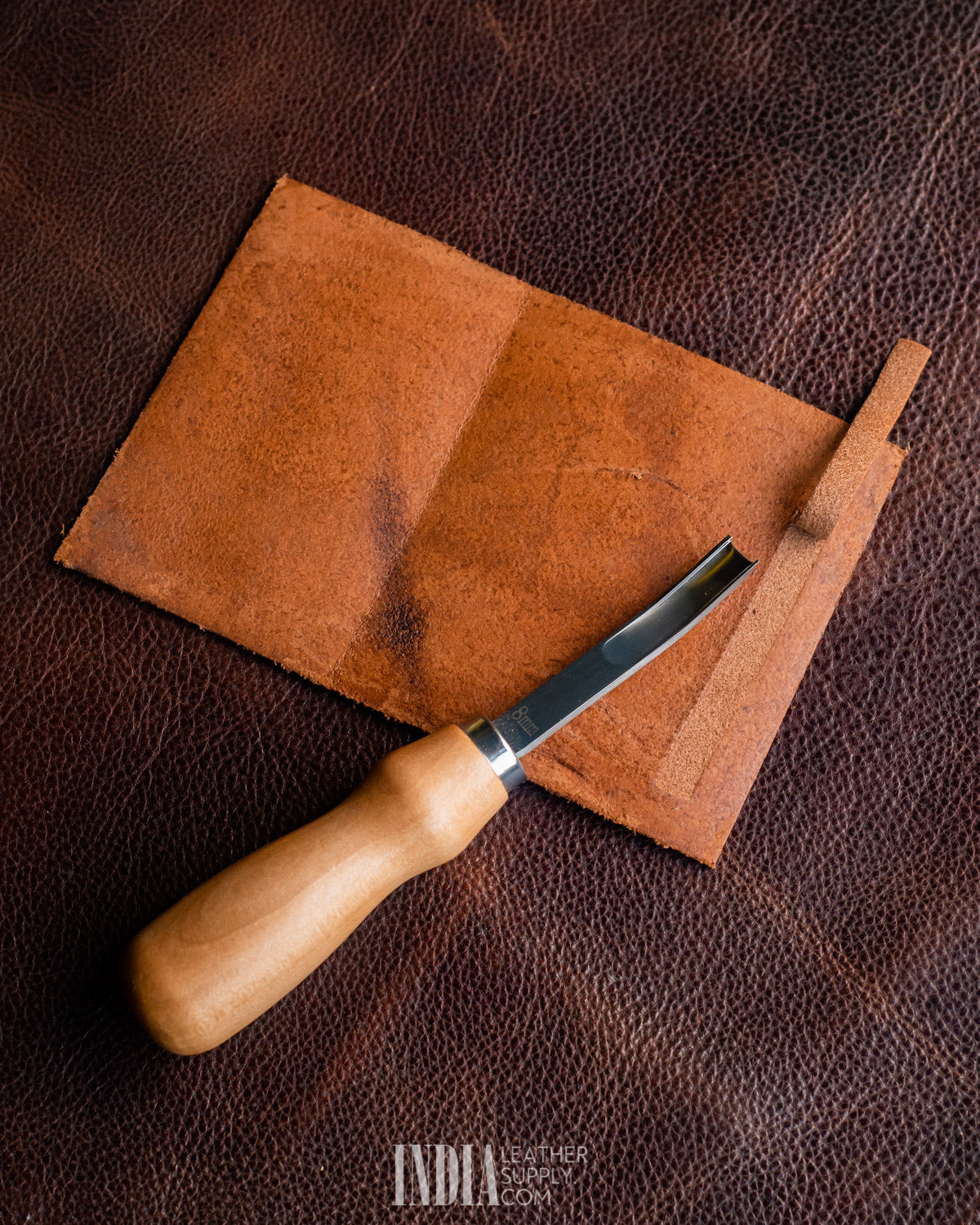


8mm French Skiver
8mm French Skiver
Couldn't load pickup availability
The 8mm French Skiver is a push-style hand tool for thinning leather in narrow, controlled strips. Its U-shaped blade scoops a shallow channel out of the flesh side as you push it forward, which makes it one of the easiest skiving tools to pick up. The depth of cut is governed by the angle you hold it at, so it is far more forgiving than a flat skiving knife.
At 8mm wide, this is the size for detail work: fold lines, turned edges, strap ends and small components where a wider skiver would take off too much. For broader areas, simply make several overlapping passes side by side.
Why Skive at All?
Wherever leather is folded, overlapped or stitched in layers, the thickness adds up. Removing a little material from the flesh side lets a fold sit flat, keeps seams from turning bulky, and gives finished goods a slimmer, cleaner profile. It is often the difference between a wallet that looks handmade and one that looks professionally made.
Applications
📐 Fold Lines
Cut a channel along the fold so thick leather bends cleanly.
↩️ Turned Edges
Thin the edge before folding it over for a neat, flat turn.
👛 Overlaps & Pockets
Reduce bulk where layers stack, such as wallet pockets and card slots.
🔗 Strap & Belt Ends
Thin the section that wraps around a buckle or hardware.
📉 Tapering
Taper the ends of straps, gussets and small components.
🎯 Spot Thinning
Reach small areas that a wider skiver cannot.
Key Features
📏 8mm Blade Width
Narrow enough for fold lines, edges and small parts, with precise control over where material is removed.
🥄 U-Shaped Scoop Profile
Lifts out a shallow channel that is thinnest in the middle and blends out at the sides, so there is no hard step in the leather.
👉 Push-Cut Action
You push the tool away from you along the leather. Raise the handle to cut deeper, lower it to cut shallower.
🎓 Beginner-Friendly
Easier to control than a flat skiving knife and much less likely to cut straight through your work.
How to Use
Set up. Lay the leather flesh side up on a hard, smooth surface such as a granite or glass slab.
Mark. Draw the line or area you want to thin.
Push. Hold the skiver at a low angle and push it forward in a smooth, steady stroke.
Go light. Remove a little at a time and repeat, instead of digging in on the first pass.
Widen. For a broader skive, make overlapping passes side by side until the area is even.
💡 Tips for a Cleaner Skive
✓ Use it on firm leather. It works best on firm leathers such as vegetable-tanned leather. It is not recommended for soft, stretchy leathers, which move and bunch under the blade.
✓ Practise first. Try an offcut of the same leather to find the right angle.
✓ Sharpness over pressure. If the tool drags or tears instead of slicing, it needs stropping or sharpening.
✓ Watch the grain side. If the skived area starts to show through on the front, you have gone deep enough.
Sharpening & Maintenance
Like any skiving tool, this one only works well when it is properly sharp, and a few minutes of sharpening makes a noticeable difference. You will need a few grades of emery paper (wet-and-dry paper), a leather strop and a sharpening compound.
Lay out the emery papers. Place the paper on a flat, hard surface such as a glass or granite slab. Work from coarse to fine, for example 400, 800, 1500 and 2000 grit. Start at the coarsest grade only if the edge is dull or nicked; for a routine touch-up, begin at 1000 or finer.
Work the bevel. Rest the bevelled face of the cutting edge flat on the paper and draw the tool backwards, away from the edge, keeping the existing angle. Repeat with even strokes until the scratch pattern is uniform, then move to the next finer grade.
Clean up the inside of the channel. Wrap fine emery paper around a thin rod, dowel or folded strip of leather that fits the channel, and make a few light strokes to remove the burr raised on the inside.
Strop with compound. Rub a sharpening compound onto a leather strop and draw the edge backwards along it 15 to 20 times. For the inside of the channel, use the edge of the strop or a strip of leather loaded with compound. This polishes the edge and removes the last of the burr.
Test. Try the tool on an offcut of firm leather. It should lift a clean, continuous strip with light pressure.
🔧 Keeping It Sharp
✓ Strop often, sharpen rarely. A quick strop before each session keeps the edge keen. Go back to emery paper only when stropping no longer restores it.
✓ Always pull, never push. Draw the edge backwards on paper and strop. Pushing into them will cut the surface and round over the edge.
✓ Store it dry. Wipe the blade after use, apply a light coat of oil before long-term storage, and keep the edge protected from other tools.
Specifications
| Specification | Detail |
|---|---|
| Tool Type | French Skiver |
| Blade Width | 8 mm |
| Overall Length | ~163 mm |
| Blade Material | Steel |
| Handle | Wood |
| Quantity | 1 pc |
⚠️ Safety Notice: The blade is sharp. Always push the tool away from your body and keep your holding hand behind the cutting edge, never in front of it. Keep out of reach of children.
Workshop Grade Tool: This is a functional workshop tool, not a showpiece. Minor tooling marks, finish variation and small handling marks may be present and do not affect function. The handle is natural wood, so grain and colour will vary between pieces.
Share