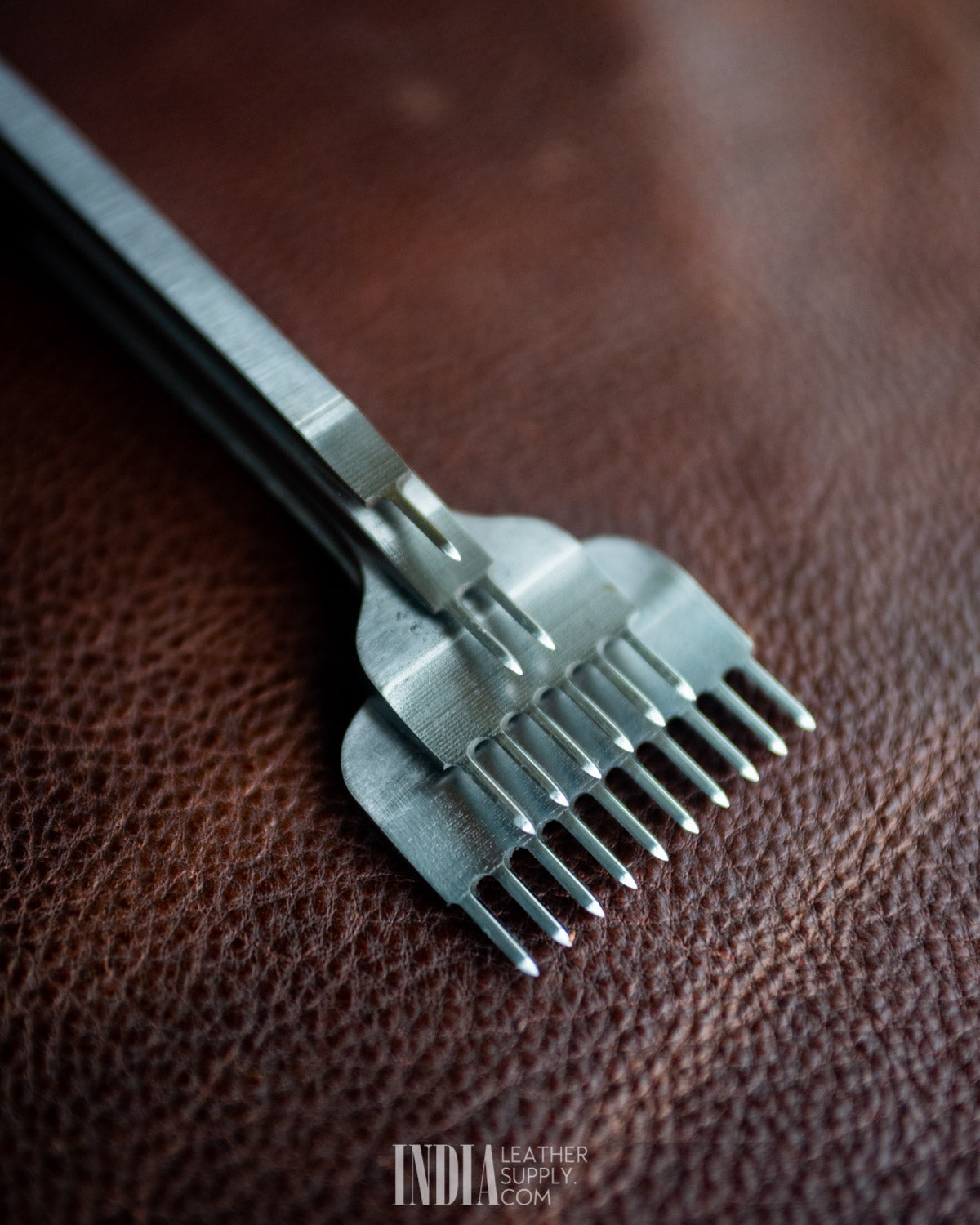


Stitching Chisels (Diamond Shaped) - Japanese Style (1+2+6+10 teeth)
Stitching Chisels (Diamond Shaped) - Japanese Style (1+2+6+10 teeth)
Couldn't load pickup availability
A set of four diamond-shaped stitching chisels in the Japanese style, for clean, evenly spaced holes for hand saddle stitching. The diamond holes give the neat, slanted stitch line that saddle stitching is known for.
The set is built around a 1 + 2 + 6 + 10 teeth layout. The 10-tooth chisel covers long straight runs quickly, the 6-tooth handles shorter lines, and the 1- and 2-tooth chisels take care of curves, corners and tight spots.
Key Features
💎 Diamond-shaped teeth
Angled holes for the classic slanted look of hand saddle stitching.
📏 10-tooth for long runs
Punches a long line in fewer strikes, keeping spacing consistent along straight edges.
✨ Polished between the teeth
Smooth tooth faces release cleanly, so the chisel does not drag the leather out of the hole as you pull it free.
🔩 Alloy steel
Sturdy chisels that stand up to repeated striking.
How to Use
- Mark your stitch line with a groover or wing divider.
- Work on a firm punching board and strike the chisel squarely with a mallet.
- For the next strike, place the first tooth in the last hole you made so the spacing stays even all the way along.
- Switch to the 2-tooth or 1-tooth chisel to walk around curves and corners.
Choosing the Spacing
The spacing is the distance from the centre of one hole to the next. It sets how dense the stitching is and how bold the seam looks. Both options here are on the finer side, suited to small leather goods.
| Spacing | Stitches per 10 cm | Look | Good For |
|---|---|---|---|
| 3 mm | ~33 | Very fine and dense | Card holders, watch straps and small, delicate pieces |
| 4 mm | ~25 | Dense and refined | Wallets, card holders and small accessories |
Product Specifications
| Specification | Value |
|---|---|
| Tooth Shape | Diamond (Japanese style) |
| Contents | 4 chisels: 1, 2, 6 and 10 teeth |
| Spacing | 3 mm or 4 mm |
| Material | Alloy steel |
⚠️ Always punch on a proper punching board, never directly on a hard surface — striking the teeth against stone, metal or concrete will blunt or chip them.
Share