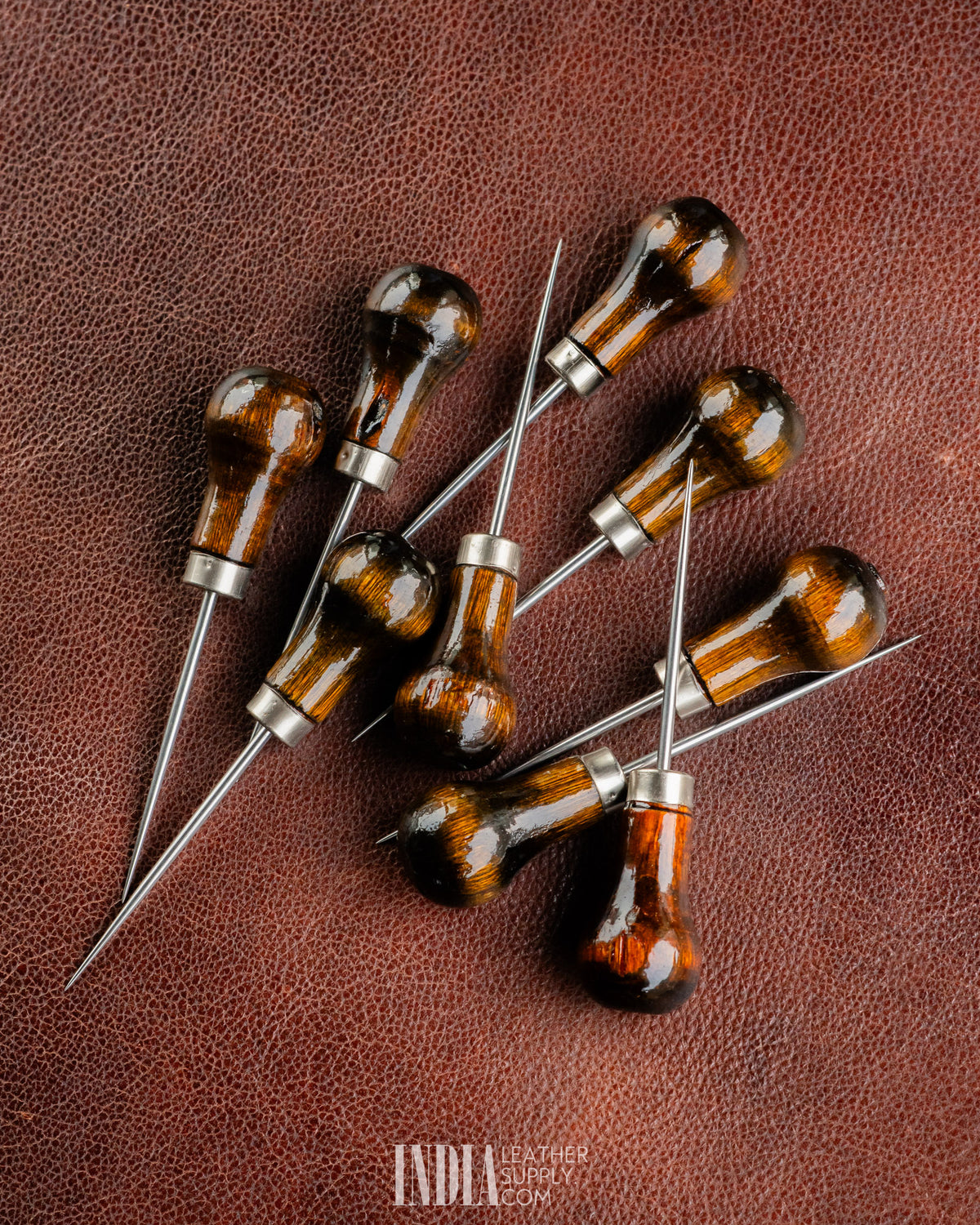


Saddler's Scratch Awl
Saddler's Scratch Awl
Couldn't load pickup availability
The Saddler's Scratch Awl has a rich hardwood handle with a nickel ferrule, shaped into a compact bulb that sits naturally in the palm. It is the go-to tool for marking stitch lines, transferring patterns and all the layout work that happens before the stitching begins.
The fine needle profile keeps the point in clear view as you work, so it is easy to trace accurately and stay on line. It is best suited to light and medium-weight leather.
What It Is For
- Marking stitch lines and cut lines
- Transferring patterns from a template to the leather
- Opening up existing stitch holes
- Light piercing work
Key Features
🤚 Palm-Grip Bulb Handle
A compact hardwood bulb that rests in the palm for steady control through long layout sessions.
🎯 Fine Needle Profile
A slim point that leaves the line in view, for precise marking right where you want it.
🔩 Nickel Ferrule
A metal collar where the needle meets the handle, holding the two firmly together.
📐 Made for Layout
Built for marking and tracing, the first step of every project before cutting and stitching.
💡 Tips for Clean Marking
✓ Work on a mat. Mark on a Self Healing Cutting Mat so the point never meets a hard surface and stays sharp.
✓ Pair it with a divider. Run the stitch line with a Wing Divider, then use the awl to mark corners, pattern points and anything off the edge.
✓ Press lightly. A scratched line on smooth leather does not come out, so keep marks on the flesh side or inside the seam allowance wherever you can.
✓ Going heavier? For thick leather and regular piercing, our Leather Marking & Piercing SS Awl is the sturdier choice.
Specifications
| Specification | Detail |
|---|---|
| Handle Material | Hardwood |
| Ferrule | Nickel |
| Handle Style | Bulb / Palm-Grip |
| Needle Profile | Fine |
| Overall Length | ~115 mm |
| Suitable Leather | Light to medium weight |
| Primary Use | Marking, Tracing & Pattern Transfer |
Note: The handle is made from natural hardwood. Grain pattern, colour tone and surface texture will vary between pieces. This is a normal characteristic of the material, not a defect. As a workshop tool, minor surface marks or finish variation may be present and do not affect function or durability.
Share